
the slowest of all fashion !
the slowest of all fashion !
one-of-a-kind garments cut from rare vintage textiles
feed sacks. grain bags. antique linens.
military blankets. vintage fabrics.
• 1900-1990s • no new fabrics ever •
Why Vintage
Textiles Matter
Before mass production, fabric was precious.
Antique linens were woven from natural fibers, long before industrial agriculture and chemical processing reshaped the materials we wear today. Their color, weight, and strength have endured, simply proven by still being here.
Feed sacks carry over a century of history. Originally used to transport animal feed, flour, sugar, and grain across the country, they were later saved, washed, and transformed into clothing and household goods by women who understood scarcity and possibility.
Today, these textiles are rare and survive in limited quantities.
I source each material individually, with intention.
Every garment is built from history that cannot be remade.
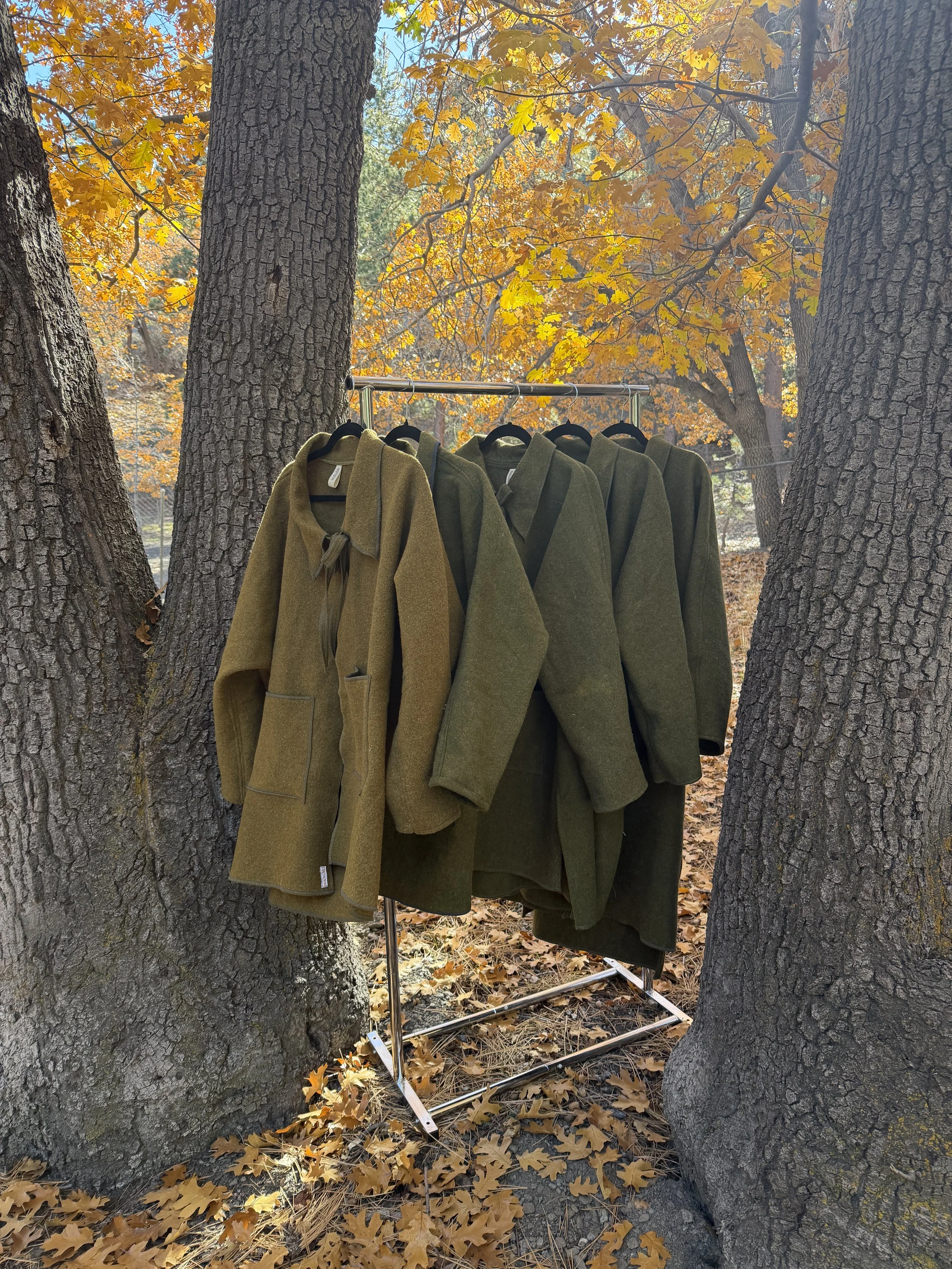
reconstructed wool coats
1960s wool military blankets, cut and rebuilt into structured, everyday coats.
heavyweight. durable. one of a kind.
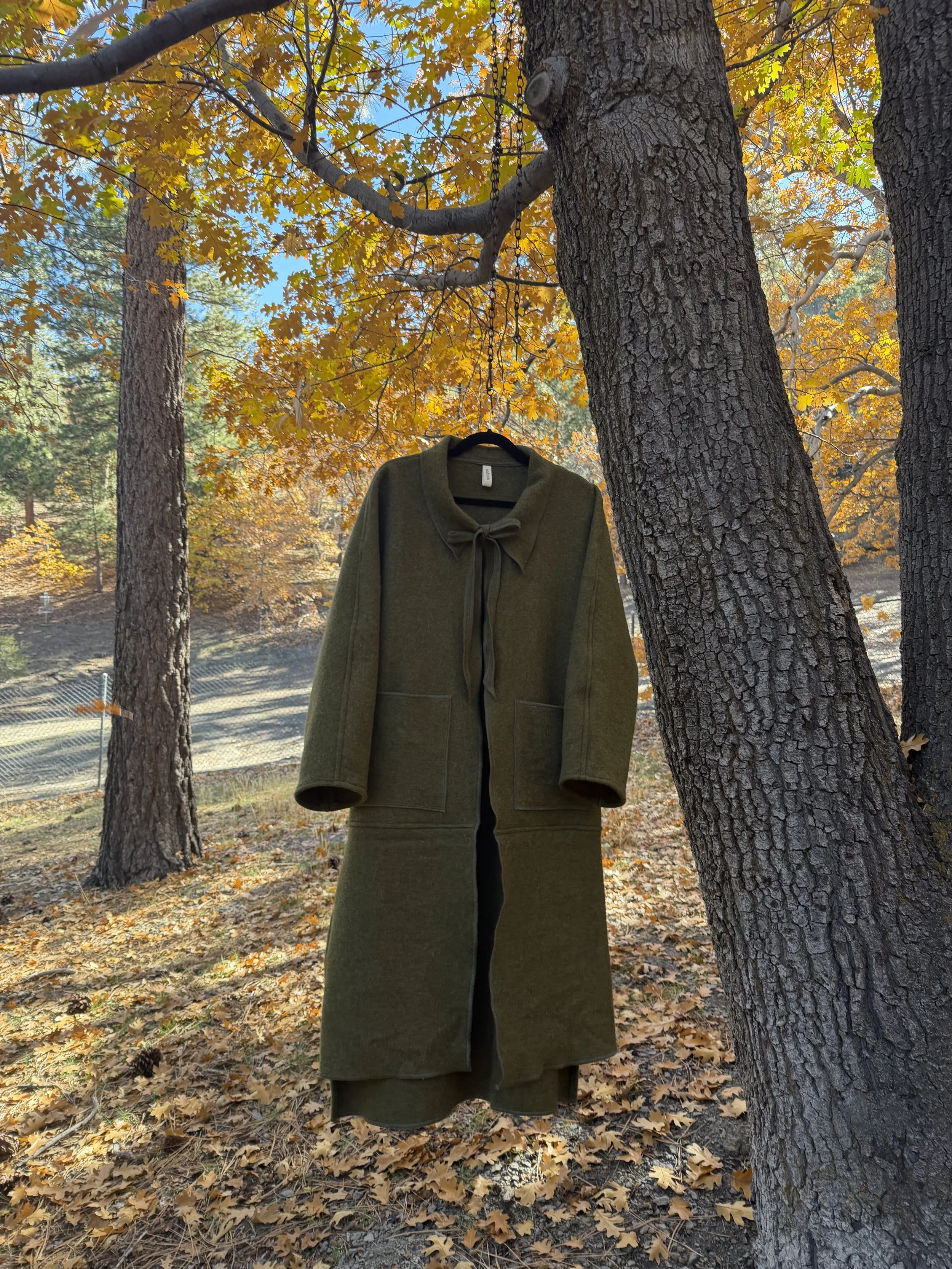
A little piece of American military medical history, given a whole new life!
Made entirely from an original vintage olive-green U.S. military wool blanket, estimated to date to the 1980s. Originally designed for warmth, durability, and years of use, the thick, beautifully aged wool has that wonderful substantial weight that makes these old blankets so special. Now transformed into a one-of-a-kind maxi coat meant to last another lifetime!
What makes this piece especially extraordinary is the original U.S. Army Medical Department insignia, carefully preserved and displayed on the upper back of the coat! The faded black emblem features a winged caduceus, with two snakes wrapped around a staff, flanked by the letters U and S. A symbol of military medicine, this historic marking offers a wonderful glimpse into the blanket's past and the people and places it may have served.
Designed with an oversized collar, hand-cut neck ties, roomy patch pockets, exposed stitching, and a beautifully elongated maxi silhouette. The full-length design gives this coat an especially dramatic shape, while the muted olive wool and original medical insignia make it a truly special wearable heirloom.
A blanket with a history, a coat with a second life!
size: M-L (fits S for an oversized look) | Pit to pit: 28” / Length (shoulder to hem): 43”
made with: 1 original vintage U.S. Army medical wool blanket / wool / ~1980s
sewn: 11/5 in California over 5 hours
fyi:
+ spot clean or dry clean only +
+ made from vintage materials • slight imperfections add to its story +
+ sewn slow in california
everyday heirlooms
original 1930s–1950s American feed sacks
continuing the tradition of turning sacks into clothing
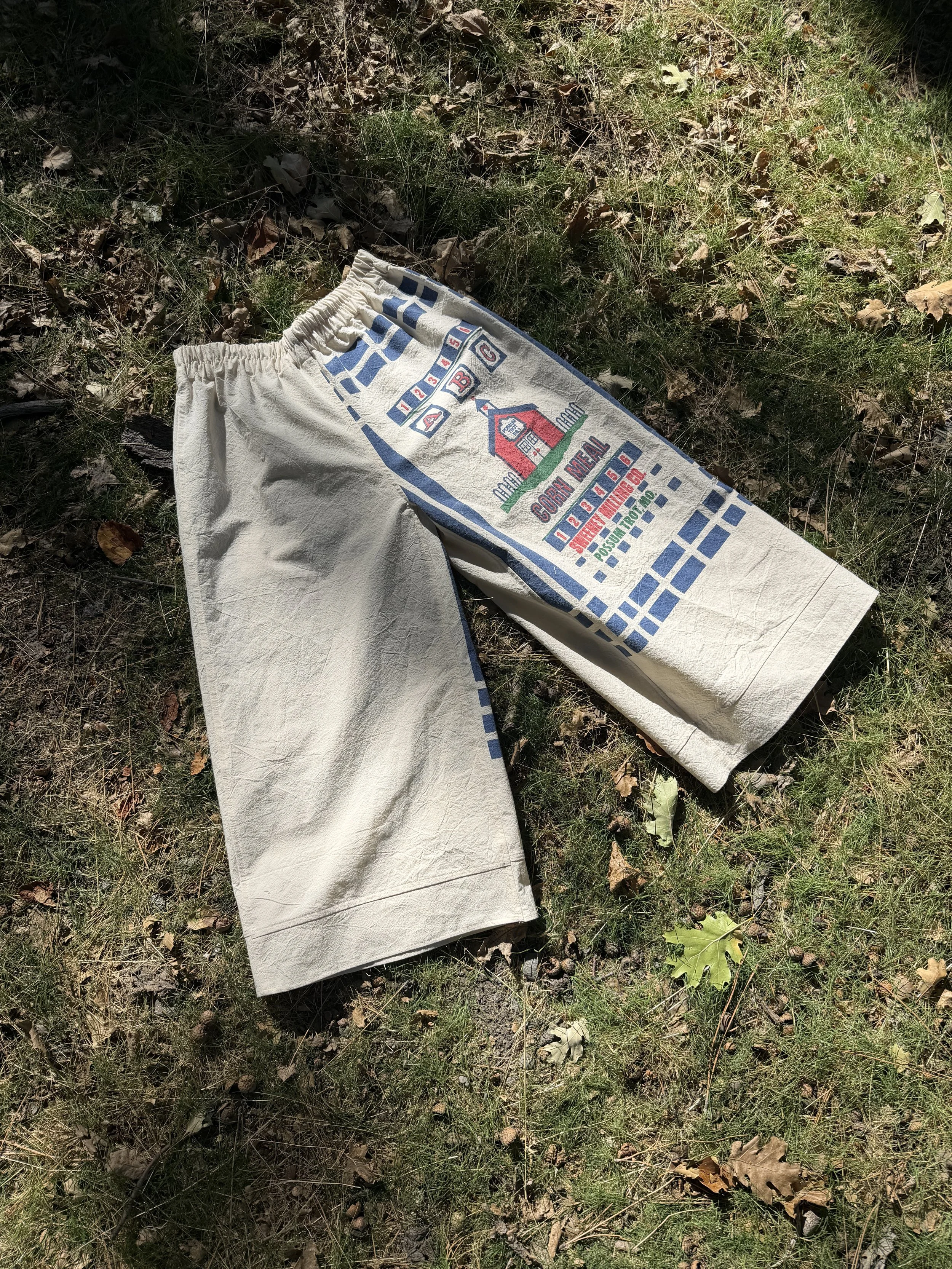
a little piece of old-school Americana! made from two original ABC Corn Meal sacks dating to the 1940s, featuring the sweetest little red schoolhouse, alphabet blocks, and bold blue geometric borders. originally used to package corn meal for the Sperry Milling Co. in Possum Trot, Missouri, these colorful cotton sacks are a reminder of a time when everyday packaging was designed to be reused rather than thrown away.
the matching schoolhouse graphics make a statement down one leg, while the other is left beautifully simple, letting the original cotton and its natural texture shine. finished with a comfy elastic waist and relaxed wide-leg fit for easy everyday wear. a little agricultural history, a little nostalgia, and a whole lot of charm! every pair comes with a matching scrunchie because no scrap goes to waste ✂️
size: M-L / 30"-36" waist / 39" length (note: these pants are very forgiving • designed to comfortably fit a wider range of bodies than the letter size suggests)
made with: 2 original ABC Corn Meal sacks / vintage cotton / ~1940s
sewn: 10/8 in California in over 5 hours
fyi:
+ best cared for by hand • machine wash cold on gentle cycle if needed
+ made from vintage materials • slight imperfections add to its story +
+ sewn slow in california
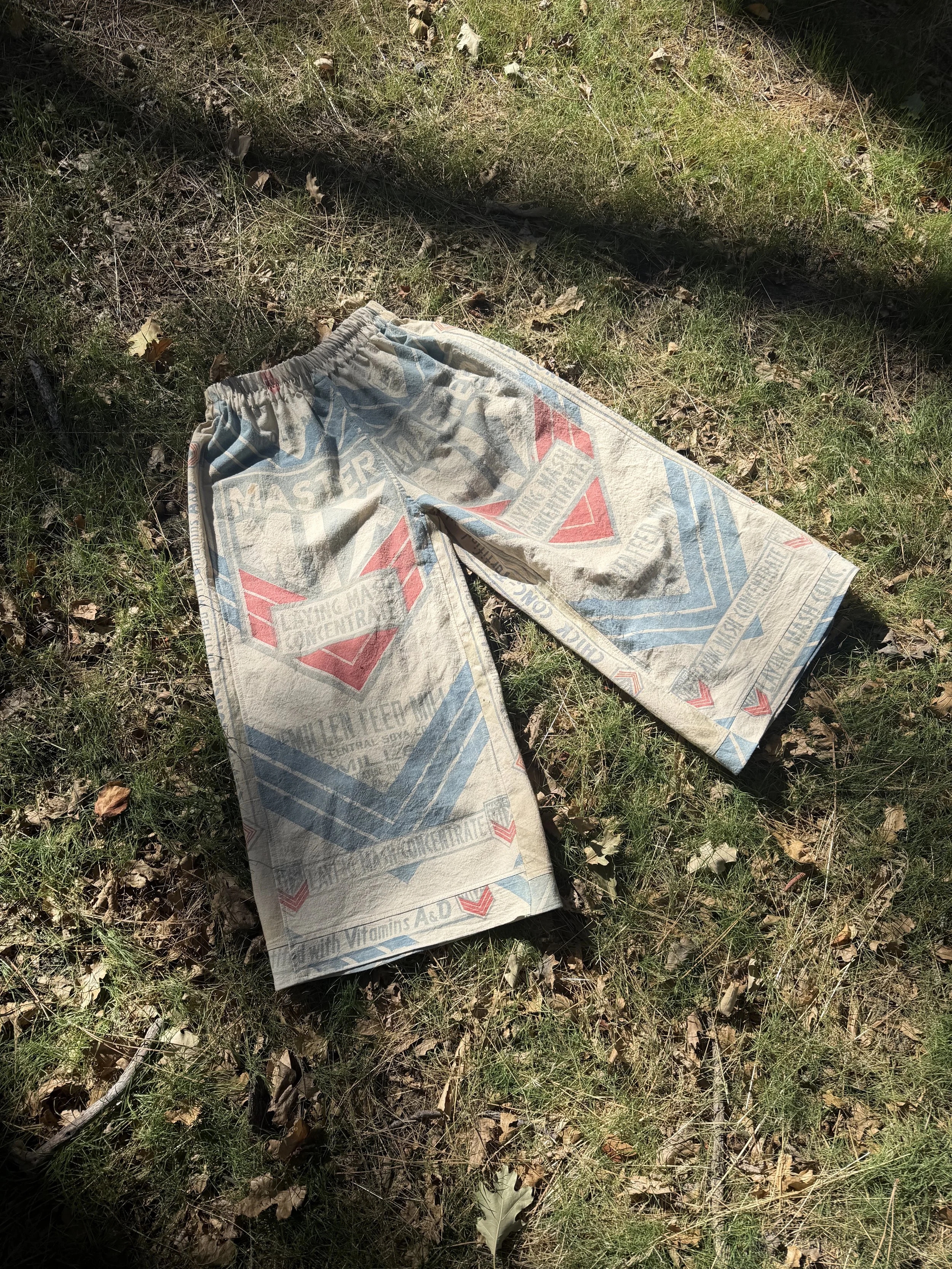
faded to perfection! made from two original Master Mix feed sacks dating to the 1940s, these pants are covered in beautifully worn blue and red graphics that have softened with decades of age. originally used to package 100 pounds of poultry feed concentrate by McMillen Feed Mills of Fort Wayne, Indiana, these cotton sacks once carried feed for America's farms before finding an entirely new life as wearable art.
the oversized Master Mix lettering, bold geometric borders, and little red arrows wrap around both legs, creating an incredible all-over graphic. years of fading have given the original cotton a soft, washed-out blue and dusty red color palette that simply cannot be recreated! finished with a comfy elastic waist and relaxed wide-leg fit for easy everyday wear. every pair comes with a matching scrunchie because no scrap goes to waste ✂️
size: M-L / 30"-36" waist / 39" length (note: these pants are very forgiving • designed to comfortably fit a wider range of bodies than the letter size suggests)
made with: 2 original Master Mix feed sacks / 100% cotton / ~1940s
sewn: 10/7 in California in over 5 hours
fyi:
+ best cared for by hand • machine wash cold on gentle cycle if needed +
+ made from vintage materials • original fading, discoloration, and slight imperfections add to their story +
+ sewn slow in california
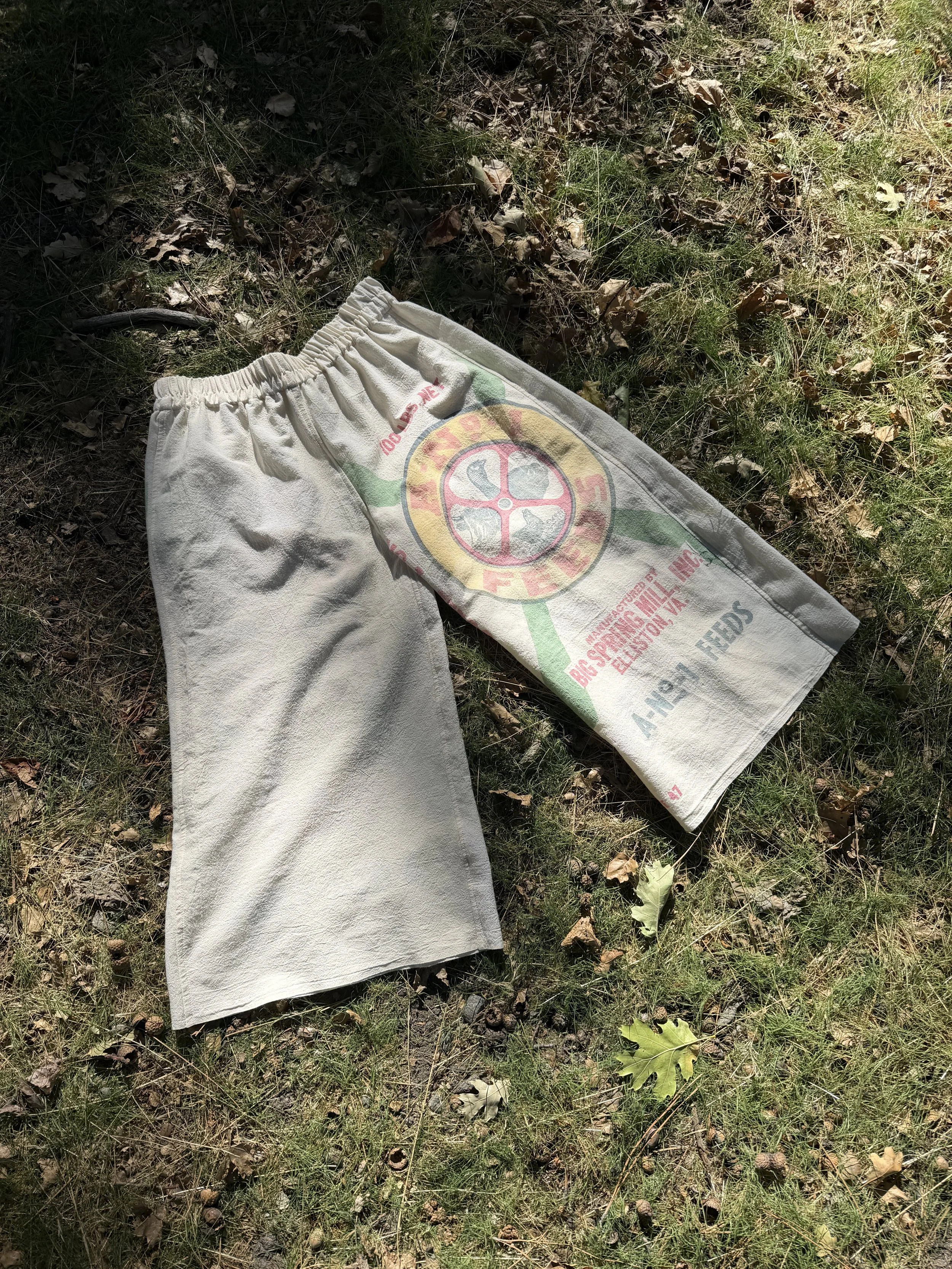
a little piece of Virginia farming history, made into something new!
made from two original 100 lb. cotton feed sacks from Big Spring Mill, Inc. of Elliston, Virginia. These beauties feature an incredible oversized A-NO-1 FEEDS emblem in faded red, butter yellow, soft green, and dusty blue, with four little animal illustrations tucked inside the circular design.
the original graphics are especially wonderful, with bold green X-shaped stripes, "A-NO-1 FEEDS" printed along the sides, and the mill's original name and location still visible near the bottom. even the tiny red "SIZE 47" marking survives!
I especially love the contrast between the colorful oversized artwork running down one leg and the beautifully simple ivory cotton on the other. Finished with a comfortable elastic waist and an easy, wide-leg silhouette. A wonderfully worn, one-of-a-kind piece of history, ready for another lifetime of adventures!
size: M-L / 30"-36" waist / 39" length (note: these pants are very forgiving • designed to comfortably fit a wider range of bodies than the letter size suggests)
made with: 2 original A-NO-1 feed sacks / 100% cotton / ~1940s
sewn: 10/8 in California in over 5 hours
fyi:
+ best cared for by hand • machine wash cold on gentle cycle if needed +
+ made from vintage materials • slight imperfections add to its story +
+ sewn slow in california
100 year old sack coats
handmade coats cut from original grain, flour, and feed sacks.
stenciled markings, worn canvas, and the honest patina of history remain intact.

June 1944. The month American forces landed on the beaches of Normandy. That is the date stamped on this flour sack by The Sherlock Baking Company, Toledo, Ohio. Wartime flour rationing was in full effect. Bakeries were working with government-allocated supplies, adjusting recipes, printing dates on their sacks to track inventory.
The red text reading Barryton Co-Op Feeds visible on the front panel is printed on the inside of this sack. The Sherlock Baking Company turned a used feed cooperative sack inside out and refilled it with flour. Two separate businesses, Two uses. One piece of cotton. Wartime made nothing disposable.
The staining is a direct physical record of that. A Toledo bakery, wartime, flour moving through rationed hands. It is not damage. It is documentation. This one survived.
+ size: M-L (S Oversized)
+made with: The Sherlock Baking Company flour sack / previously used as Barryton Co-Op Feed sack / 100% cotton / Toledo, Ohio | Mecosta County, Michigan / June 1944
+ sewn: on 2/2-3/26 in Missoula, MT over 10 hours
FYI:
+ best cared for by hand • machine wash cold on gentle cycle if needed +
+ made from vintage materials • slight imperfections add to its story +
+ made in montana

The year 1941 is printed directly on this sack. Not estimated. Not approximated. Stenciled in black ink by De Kalb Agricultural Association, the Illinois seed corn cooperative that by 1940 led the nation in hybrid seed corn sales. In 1941, the year on this sack, De Kalb was simultaneously supplying seed corn to the U.S. government as part of the Allied war effort. This sack was part of that.
The second sack is Bemis Bros. "A Seamless," woven on tubular looms without side seams, extra heavy grade, the premium cotton sacking of its era. The Bemis mark sits on the back panel. The De Kalb stenciling runs vertically down the front. Both are original. Nothing was cleaned away.
Maxi coat. Wide collar. Tie closure. Two front pockets. Sewn slow.
+size: M–L / fits S oversized
+made with: De Kalb Agricultural Association hybrid seed corn sack + Bemis "A Seamless" grain sack / 100% cotton / DeKalb, Illinois / 1941
+sewn: 1/29–2/1/26 in Missoula, MT over 10 hours
+fyi:
best cared for by hand · machine wash cold on gentle cycle if needed
made from vintage materials · slight imperfections add to its story
the date 1941 is original to the textile, stenciled at time of production

Someone named Les Thein stenciled his name across the top of this sack in red paint, probably a grain dealer or farm operator marking his sacks so they'd come back to him. In the early 20th century, a good sack was worth returning. The name stayed. Everything else about his life is unknown.
Thein is a German-origin surname concentrated heavily in Wisconsin, Minnesota, and the Dakotas. A Les Thein farming or dealing grain somewhere in the grain belt in the 1920s–40s is entirely consistent with the sack's weight grade, the Bemis origin, and the wear pattern.
The sacks themselves are Bemis Bros. "A Seamless", woven on tubular looms without side seams, considered a premium product, and built to be worked hard and reused. Bemis was one of the largest bag manufacturers in the United States. The cotton dates to approximately the 1920s–1930s. The wear, the staining, the patina are all original. e.
Maxi coat. Wide collar. Tie closure. Two front pockets. Sewn slow.
+size: M–L /fits S oversized
+made with: 2 — Bemis "A Seamless" grain sacks / 100% cotton / USA / 1920s-40s
+sewn: 1/29–2/1/26 in Missoula, MT over 10 hours
+fyi:
best cared for by hand · machine wash cold on gentle cycle if needed
made from vintage materials · slight imperfections add to its story
the name LES.THEIN is original to the sack - applied by the owner, not added